

CQB Airsoft Playbook: Room Clearing, Pieing Corners and Team Roles
NOVEMBER 10, 2025
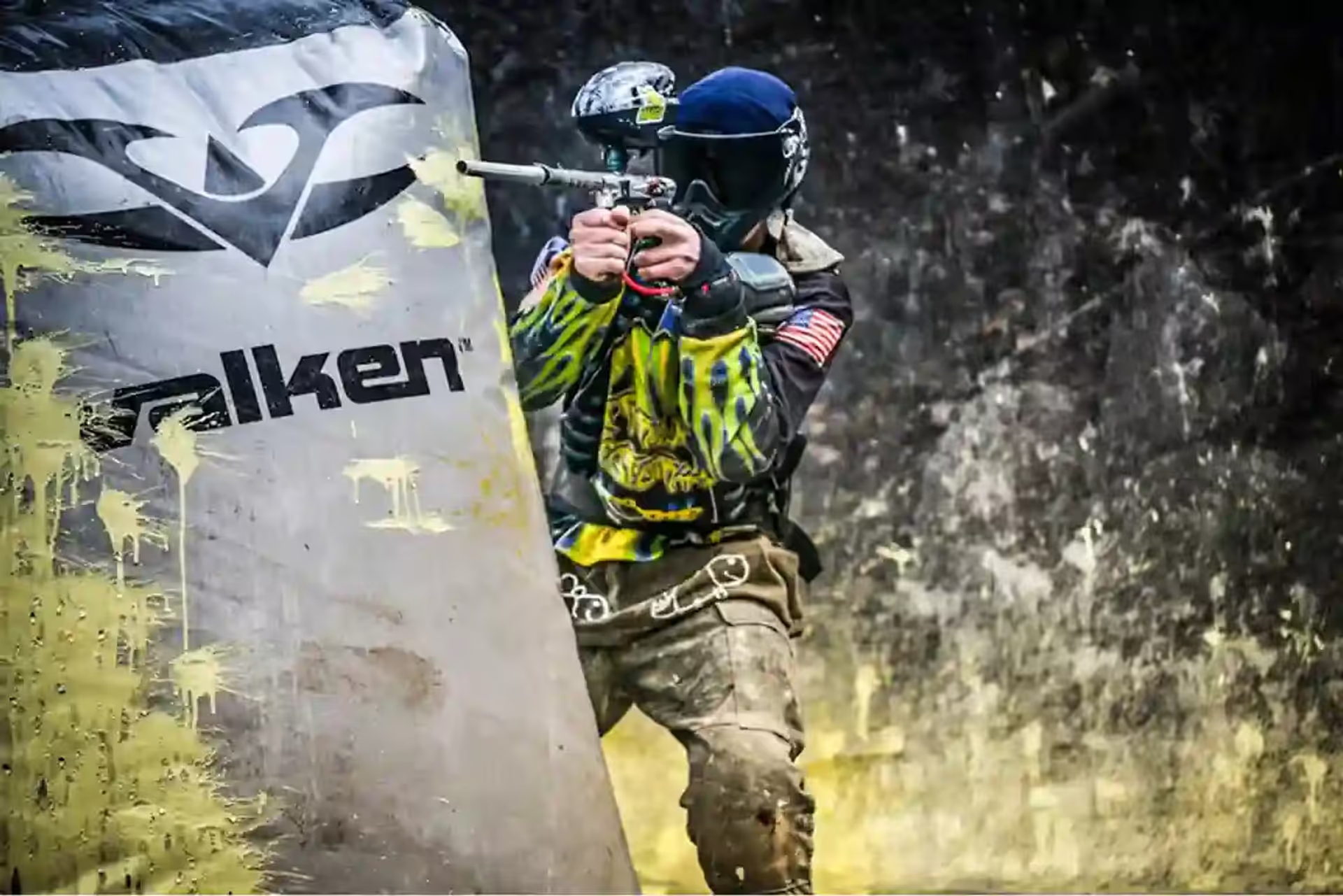
The difference between woodsball and speedball isn't just about where you play—it's about how you think. Woodsball rewards patience, reading terrain, and executing deliberate flanking maneuvers that unfold over minutes. Speedball demands explosive breakouts, split-second lane awareness, and coordinated pushes that decide games in seconds. Both formats require tactical intelligence, disciplined communication, and teamwork that transcends individual shooting ability, yet the specific strategies that win woodsball games will get you eliminated instantly on speedball fields, and vice versa.
Understanding these tactical differences transforms average players into threats their opponents respect. A speedball player who masters breakout lanes and bunker codes but steps onto a wooded field without adapting their approach will find themselves outflanked and eliminated by players who understand natural cover and patient positioning. Similarly, woodsball veterans accustomed to slow, methodical advances often freeze during speedball's chaotic opening seconds, unable to process the explosive pace and angular complexity of artificial bunker fields.
This comprehensive guide breaks down field-tested tactics for both formats—strategies proven at local recreational fields, regional tournaments, and national-level competition. We'll cover the fundamentals that transcend both formats before diving into format-specific tactics: woodsball's flanking techniques, terrain exploitation, and scenario game strategies, then speedball's breakout systems, bunker codes, and coordinated push mechanics. Whether you're preparing for weekend recreation at fields like Liberty Paintball or Paintball USA, or training for competitive leagues following NXL tournament rules, these tactics provide immediately applicable frameworks for improving your game.
Before we dive into tactics, the critical foundation: paintball requires ASTM F1776-certified full-seal eye and face protection at all times in active play areas. The tactics discussed here assume proper safety equipment, chronographed markers within field limits, and respect for field rules and referees. No tactical advantage justifies compromising safety—ever.
The physical environment fundamentally dictates tactical possibilities. Woodsball and speedball exist on opposite ends of paintball's tactical spectrum precisely because their playing fields create entirely different strategic landscapes.
Woodsball fields utilize natural terrain—forests, hills, ravines, brush, and natural obstacles like fallen trees and rocks. Cover is irregular, asymmetric, and three-dimensional. Visibility varies dramatically based on foliage density, lighting conditions, and elevation changes. Movement options are nearly unlimited—you can approach objectives from countless angles, routes, and elevations that opponents can't fully predict or control.
This environmental complexity creates tactical opportunities impossible in speedball. You can use dead ground (depressions or terrain features hiding you from enemy observation) to approach undetected. Elevation provides observation advantages and psychological intimidation. Natural camouflage patterns break up your silhouette, making detection harder. The irregular cover means there's almost always a flanking route if you're patient and observant enough to find it.
However, woodsball's complexity also challenges situational awareness. Unlike speedball's clean sight lines, woodsball obscures enemy positions behind foliage, shadows, and terrain. You must develop enhanced listening skills, movement detection, and the ability to read subtle environmental clues—disturbed leaves, snapped branches, or unnatural shapes in natural settings. Fields like High Velocity Paintball in New York showcase classic woodsball terrain with dense forest, elevation changes, and natural fortifications that reward tactical patience.
Speedball fields feature artificial inflatable bunkers arranged in symmetric or near-symmetric patterns on flat, open terrain. Bunker types have standardized names—"snake" (long low bunkers along sidelines), "doritos" (triangular bunkers), "cans" (cylindrical bunkers), "temples" (large rectangular bunkers), and "wedges" (angular bunkers). Field dimensions are standardized for competitive play, typically 120-150 feet wide by 150-180 feet long.
This structured environment creates tactical clarity absent in woodsball. Every bunker's position, angle, and relationship to other bunkers is known and pre-planned. Players memorize bunker codes and lanes—specific shooting angles between bunkers. The field's symmetry means both teams start with equal tactical opportunities, and victory depends on execution rather than exploiting terrain advantages.
Speedball's open design and minimal cover height create constant exposure risk. Unlike woodsball where trees and brush provide overhead concealment, speedball bunkers only shield you from specific angles—step out wrong and multiple opponents have clean shots. This demands precise movement, clean communication, and constant awareness of which lanes opponents control. The flat terrain and clear sight lines mean there's nowhere to hide once opponents establish field position—you must win through superior angles, timing, and coordination rather than stealth.
The lighting in speedball is typically bright and consistent (outdoor fields) or controlled (indoor arenas), eliminating the shadows and variable visibility that woodsball players exploit. This clarity benefits snapshot accuracy and quick target acquisition but removes concealment as a tactical tool.
Before diving into format-specific tactics, certain principles apply universally to competitive paintball regardless of environment. Master these fundamentals and you'll succeed in both woodsball and speedball.
Communication separates organized teams from collections of individuals. Effective communication requires three elements: clarity (simple, unambiguous calls), brevity (information delivered in minimal words), and discipline (only relevant information, delivered at appropriate times).
Bunker codes provide standardized location references. Rather than describing positions verbally ("he's behind the triangle thing on the right"), bunker codes enable precise callouts ("Snake 2 player"). In speedball, fields use standard bunker naming conventions that teams learn during walk-throughs. In woodsball, teams create custom codes for key terrain features—"Alpha rock," "Bravo ridge," "Charlie bridge"—during pre-game reconnaissance.
Hand signals enable silent communication critical in woodsball and useful in speedball when verbal communication is compromised by suppressive fire. Basic signals include: closed fist (stop/freeze), pointing (direction of movement or enemy position), tapping head (enemy spotted), fingers held up (number of enemies), thumbs up/down (status check), and slashing throat (eliminated/cease fire).
Verbal short codes compress information into minimal syllables. "Left side hot" becomes "Hot left." "Three enemies advancing toward the center bunker" becomes "Three center push." Numbers precede locations: "Two snake" (two enemies in snake bunker), not "snake has two." Time-sensitive information gets priority—enemy movements before static positions.
According to sports psychology research from the American Psychological Association, effective team communication under pressure requires pre-established protocols, regular practice, and discipline to avoid information overload. Teams that establish communication systems in training perform dramatically better under competitive stress than teams relying on improvised communication.
Proper spacing provides mutual support while preventing single eliminations from cascading into team wipes. In woodsball, maintain 15-30 foot spacing between teammates during movement—close enough for mutual support, far enough that a single opponent can't easily engage multiple teammates. In speedball, spacing is bunker-dependent, but the principle remains: position where you can support teammates' positions without clustering in ways that let opponents engage multiple targets with single lanes.
Overlapping fields of fire ensure every approach to your position is covered by at least one teammate. If you're watching left lanes, your teammate covers right lanes and crossfield angles you can't see. This requires constant awareness of teammate positions and coordinated sector responsibility—verbally confirming "I've got left" or "Covering snake" prevents gaps in coverage.
Situational awareness—understanding enemy positions, teammate locations, available cover, dominant lanes, and tactical opportunities—separates good players from great ones. Develop this through:
Active scanning: Continuously move eyes between known enemy positions, likely enemy routes, and teammate positions. Avoid tunnel vision on single targets or angles—maintain broad awareness.
Information processing: Integrate teammate callouts with your observations. If your teammate calls "Two pushing snake," immediately think: "Which teammates can help? What angles threaten them? How does this affect my position?"
Anticipation: Predict opponent movement based on field position and game state. If you've eliminated their snake-side players, anticipate a dorito-side push. If they're winning, expect aggressive moves; if losing, expect desperation plays or bunker.
Pattern recognition: Experienced players recognize tactical patterns—teams that favor specific breakouts, players who habitually post certain bunkers, or predictable push timing. Use this intel to pre-aim likely positions or set traps.
Paintball creates genuine stress: adrenaline from movement, pressure from incoming paint, and fear of elimination. Players who maintain calm decision-making under pressure consistently outperform more skilled players who panic.
Breathing techniques help manage stress. APA sports performance research emphasizes tactical breathing—inhale for four counts, hold for four, exhale for four, hold for four—to reduce heart rate and restore cognitive function during high-stress moments. Practice this during training so it becomes automatic in games.
Visualization before games prepares your mind for game scenarios. Mentally rehearse breakouts, flanking routes, and high-pressure situations so your brain has established pathways for these scenarios. When they occur in games, you'll respond with trained patterns rather than panicked improvisation.
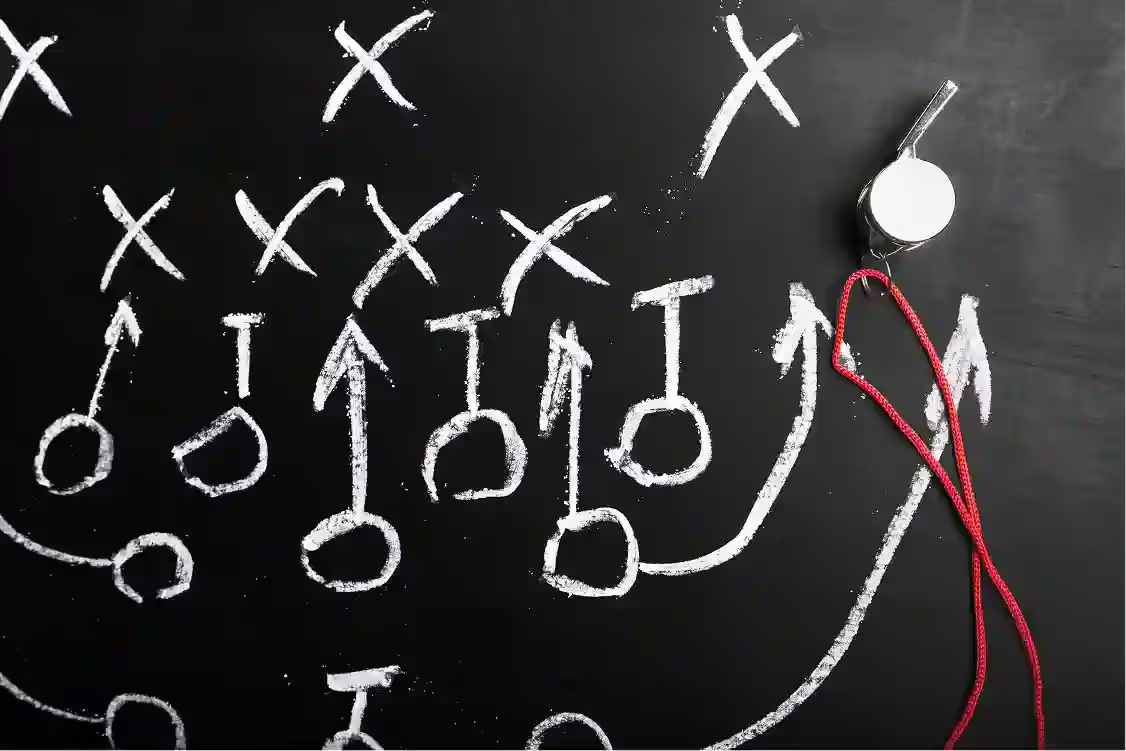
Woodsball rewards tactical patience and exploitation of three-dimensional terrain. These strategies leverage woodsball's environmental complexity to create advantages standard speedball tactics can't match.
Flanking—moving to attack enemy sides or rear while they focus on frontal threats—is woodsball's most powerful tactic. Unlike speedball where bunker fields and clear sight lines limit flanking options, woodsball's terrain provides countless flanking routes for players willing to invest the time and discipline.
Wide flanks send one or two players on extended routes far to the side (50-100+ feet beyond main engagement area) while the main force occupies enemy attention frontally. Wide flanks require patience—rushing compromises concealment—and coordination with the main element. The flanking element moves slowly and quietly, using terrain and vegetation for concealment, until they reach positions with clean shots to enemy sides or rear. The main element's job is fixing enemy attention forward, not necessarily advancing—suppressive fire and visible presence suffice.
Narrow flanks exploit local terrain advantages within the main engagement area. Rather than committing to extended routes, players use depressions, dense vegetation patches, or dead ground to move 15-30 feet laterally, gaining angles on enemies focused on the main force. Narrow flanks execute faster than wide flanks but require better terrain reading to identify usable routes.
Ambush positions involve establishing concealed positions along likely enemy routes and waiting for targets to enter kill zones. Effective ambushes require reconnaissance identifying enemy movement patterns, patience waiting (sometimes 5-10+ minutes), and fire discipline (waiting for optimal targets rather than engaging first visible enemy and compromising position). Set ambushes near objectives enemies must reach, along likely flanking routes (turn the enemy's flanks against them), or at chokepoints (bridges, trails, openings in dense vegetation).
Fields like Extreme Paintball Park in California feature terrain ideally suited for flanking—rolling hills, variable elevation, and dense foliage enabling patient tactical movements that speedball simply can't replicate.
Bounding overwatch enables safe forward movement despite enemy resistance. The technique involves alternating movement and covering fire between two elements—while one element moves, the other provides suppressive fire from stationary positions.
Successive bounds: Teams split into two elements. Element A occupies positions with good cover and fields of fire covering Element B's intended route. On signal, Element B moves forward 20-50 feet (distance depends on terrain and enemy proximity) while Element A provides suppressive fire preventing enemy observation of Element B's movement. Once Element B reaches new positions with good cover, they establish fields of fire and Element A leapfrogs forward, with Element B now providing cover. Repeat until reaching the objective.
Alternating bounds: Similar to successive bounds but elements move to positions lateral to (alongside) rather than beyond each other, creating a rolling advance rather than leapfrogging. This works well when enemy positions are to the side rather than directly forward, or when terrain prevents straight-line advances.
The key to effective bounding is synchronization. Elements must communicate when they're set (in position, ready to cover) and when they're moving. Standard calls: "Set!" (I'm in position, ready to cover your movement), "Moving!" (I'm advancing now, cover me), and "Set!" again when reaching new positions. This creates a rhythm where teams advance continuously while always having covering fire.
Bounding overwatch seems slow compared to speedball's explosive pace, but in woodsball's complex terrain, it prevents the overextension and isolated eliminations that devastate uncoordinated teams.
Woodsball's concealment opportunities only matter if you avoid compromising them through noise. Silent movement and non-verbal communication enable approaches enemy teams never detect until too late.
Minimize gear noise: Secure loose equipment that rattles or clinks. Use tape or Velcro to silence pod harness clips, secure radio antennas, and eliminate metal-on-metal contact. Test your loadout by moving vigorously—if you hear rattling, opponents will too.
Controlled foot placement: Step deliberately, rolling from heel to toe and avoiding stepping on branches or dense dry leaves when possible. Slower movement is quieter—accept that stealth requires patience. When speed is necessary, prioritize soft ground (dirt, moss) over noisy surfaces (gravel, fallen branches).
Radio discipline: If using radios (common in scenario games and tournament woodsball), establish silence protocols. Radios remain off or in vibrate mode until specific conditions—contact with enemy, reaching rally points, or scheduled check-ins. Unnecessary radio chatter compromises stealth and clutters communication during critical moments.
Hand signals for movement: In close-proximity operations (10-20 feet between teammates), hand signals replace verbal communication entirely. Beyond basic signals mentioned earlier, teams develop custom signals for specific tactics: fingers walking (flanking movement), horizontal hand swipe (linear advancement), circular motion (envelop/surround), and bringing hand to shoulder (rally to me).
Camouflage disrupts human pattern recognition, making detection harder even when opponents look directly at you. Effective camouflage combines appropriate coloration, breaking up silhouette, and smart positioning.
Color matching: Choose clothing and gear matching the predominant colors of the terrain you'll play. Woodland patterns work in forests, olive drabs in sparse vegetation, and desert patterns in sandy or arid terrain. Avoid pure black—it's too dark for most natural environments and creates a distinctive silhouette.
Pattern disruption: Human brains excel at recognizing human shapes and symmetry. Break this up through irregular patterns in clothing, adding vegetation to gear (tucking leaves or branches into pod harnesses or barrel covers), and avoiding regular geometric shapes in your setup.
Background positioning: Concealment requires considering what's behind you from the enemy's perspective. Position against dark backgrounds (dense vegetation, shadows) rather than bright backgrounds (sky, open clearings). Use terrain that breaks up your silhouette at multiple depths—vegetation both near and far creates visual complexity that hides you better than single-depth concealment.
Minimize movement: Human eyes detect movement far more easily than static objects. When concealed, minimize all movement—slow, deliberate motions when necessary, total stillness when enemies scan your area. This is why ambush positions are so effective—perfectly still players in good concealment are nearly invisible even at moderate ranges.
Woodsball games span longer durations than speedball (often 10-30 minutes versus 3-8 minutes), creating opportunities for significant tactical adjustments based on developing situations.
Lateral repositioning: If frontal approaches are too heavily defended, shift your entire team laterally to attack from different angles. Unlike speedball where bunker fields constrain repositioning options, woodsball's open terrain enables 50-100 foot lateral movements that completely change the tactical picture.
Objective assessment and flexibility: In scenario games with multiple objectives, constantly reassess which objectives are achievable, heavily defended, or vulnerable. Shift resources from low-probability objectives to high-value opportunities as the game develops. This requires leadership willing to abandon failing plans and communicate new priorities clearly.
Reinforcement of successful attacks: When teammates achieve breakthroughs or establish advantageous positions, reinforce success rather than rigidly adhering to original plans. If your left flank penetrates enemy lines, shift additional players to exploit that success rather than continuing doomed attacks elsewhere.
Defensive reorientation: When your team loses advantageous positions or suffers eliminations, establish new defensive lines using terrain features. Don't try holding untenable positions—fall back to defensible terrain, consolidate remaining forces, and restart coordinated operations from stable positions.
Large scenario events at venues like those hosted by Paintball USA feature complex objectives: defending or attacking fixed positions, controlling territory, retrieving props, or accomplishing timed missions. These require planning and tactics beyond simple elimination games.
Defensive fortification: When defending objectives, establish layered defenses. Forward observation posts detect enemy advances early, main defensive line engages attackers, and reserve force counterattacks breakthroughs or reinforces threatened sections. Use natural obstacles (streams, dense brush, elevation) to canalize attackers into kill zones.
Coordinated assaults: Attacking fortified positions requires concentration of force at decisive points while fixing defender attention elsewhere. Designate a main assault element (strongest players, best equipment) to strike a weak point in defenses, while secondary elements conduct diversionary attacks drawing defenders away from the main effort.
Smoke and deception: Smoke grenades (where permitted by field rules) create concealment for movement, simulate false attacks, or mask objective completions. Use smoke judiciously—poorly planned smoke reveals your intentions and helps defenders identify attack directions.
Time management: Scenario games often involve timed respawns or mission windows. Factor time into tactical planning—sometimes avoiding contact and running to objectives beats fighting through resistance.
Speedball is paintball's chess match played at breakneck speed—every player, bunker, and shooting lane represents tactical options that teams must process and exploit in seconds. Success demands pre-planned coordination, practiced execution, and instant adaptation when plans meet reality.
The breakout—the explosive run from start stations to first bunkers at game start—determines which team establishes field control. Breakout lanes are pre-designated shooting angles specific players engage during the first 3-5 seconds, before anyone reaches their bunkers.
Lane assignments: Each player receives specific responsibilities: "You shoot left snake runner," "You lane right dorito insert," "You cover home cross." This prevents duplicate coverage (three players shooting the same target while other threats run free) and ensures comprehensive field coverage. During pre-game walk-through, players physically stand at start positions and identify exactly which lanes they'll engage.
Shooting priority: Primary targets are opponent players running to aggressive (forward) bunkers—eliminating these immediately provides significant tactical advantages. Secondary targets are mid-field runners. Low-priority targets are home/back players—they're harder to hit at range and less immediately threatening. Shoot your primary lane first, then transition to secondary targets if your primary isn't present.
Volume and discipline: Breakout laning requires volume—sustained paint stream discouraging opponents from running through your lane—combined with discipline to stay on your assigned lane rather than chasing attractive targets in other players' responsibility zones. NXL tournament footage shows professional teams executing this with military precision—each player engaging specific lanes regardless of tempting targets elsewhere.
Timing and synchronization: Coordinated breakouts happen on verbal or visual signals. Many teams use countdowns ("3-2-1-break!") ensuring simultaneous explosion from start positions. Synchronized breakouts prevent staggered running where early runners draw fire without support, or late runners arrive after opponents establish positions.
Bunker codes enable precise, instantaneous communication about field positions. Rather than describing locations verbally, codes compress position information into 2-3 syllables.
Standard bunker naming: Most speedball fields use variations on common systems:
Zone numbering and grid systems: Some teams overlay numeric grids (dividing the field into 3x3 or 4x4 zones) providing non-bunker-specific position references: "Enemy in Zone 5" (center-right midfield). This helps communicate positions between bunkers or in dead zones.
Callout discipline: Effective callouts include position and action: "Snake 2 player" (enemy occupying that bunker), "Runner to dorito 3" (enemy moving to that location), "Snake 2 eliminated" (that position now empty). Omitting action creates ambiguity—"Snake 2" could mean enemy there, asking teammate to post there, or reporting elimination.
Speedball's tight bunkers and clear sight lines mean excessive exposure equals elimination. Snapshot technique enables engaging opponents while minimizing your profile.
Individual player skill matters less in speedball than coordinated timing. Average players executing synchronized pushes defeat superior shooters moving independently.
Suppression and movement: Pushes require teammates to provide suppressive fire (continuous paint stream preventing opponents from engaging the moving player). The mover communicates: "Pushing snake on three—2-1-pushing!" Covering teammates immediately lay suppressive fire into positions threatening the snake runner, who explodes forward during the suppression window.
Multiple simultaneous movements: Coordinated pushes involve multiple players moving simultaneously to different bunkers, overwhelming opponents' ability to engage all threats. "Double move snake and dorito—ready—go!" forces opponents to choose which threat to engage, often resulting in at least one successful advancement.
Reading opportune moments: Pushes succeed when opponents are distracted (reloading, dealing with different threats, or out of position). Watch for these windows: after eliminating enemy players (fewer guns opposing your move), when opponents focus elsewhere (pressuring your teammates on opposite side), or when their attention is locked forward (they won't see lateral movements).
Conservative advancement: Not every game requires aggressive pushing. Sometimes maintaining position and control is tactically superior to risky advances. If you're winning eliminations and time favors your team, avoid unnecessary risks—force opponents to make desperation moves and capitalize on their mistakes.
Experienced speedball players recognize patterns in opponent behavior and adjust tactics accordingly.
Speedball positions carry specific tactical responsibilities beyond "shoot opponents."
Back/anchor players: Establish in home bunkers or rear positions providing field-wide vision and long-range fire support. Anchors' primary responsibility is communication—calling opponent positions, eliminations, and movement patterns to teammates whose bunker positions limit their field vision. Secondary responsibility is providing suppressive fire supporting teammates' movements and controlling center lanes preventing opponent advances.
Mid players: Bridge between anchors and fronts, typically posting in center bunkers. Mids provide versatility—they support front players' aggressive moves, reinforce anchors when back positions are threatened, and control critical center lanes that dictate field control. Mids must balance offense and defense, pushing when opportunities arise but falling back to anchor when fronts are eliminated.
Front players: Occupy aggressive forward bunkers (snake/dorito ends, wire bunkers) applying pressure and gaining eliminations. Fronts' responsibility is creating opportunities—eliminating opponents, forcing them into defensive postures, and opening lanes for teammates to push. Front players accept higher elimination risk in exchange for high-impact plays when successful. The best fronts know when to take calculated risks versus when to play conservative maintaining position.
Professional speedball is often decided in the first 10 seconds. Teams executing clean breakouts with effective laning establish field control that's difficult to overcome. Here's the critical sequence:
Games extending beyond 30 seconds enter tactical phases where teams maneuver for advantages through coordinated movements, but those first 30 seconds determine who controls the field geometry.
Effective tactics require equipment supporting your format's specific demands. Gear optimized for one format often hinders performance in the other.
Camouflage clothing matching your terrain breaks up silhouette and aids concealment. Choose patterns appropriate for your predominant playing environment—woodland digital, MARPAT, or traditional woodland camo for forests; tan, desert, or multicam for arid terrain. Avoid pure black unless playing in extremely low-light facilities.
Hydration systems are essential for woodsball's longer game durations and physical demands of moving through natural terrain. Hydration packs (2-3 liter capacity) enable drinking without removing gear, critical during continuous play. Place water bladders inside packs or integrated carriers—dangling canteens create noise and snag on vegetation.
Pod harnesses for woodsball should be sturdy (withstanding crawling, diving into brush) with secure retention (preventing pods from falling out during rough movement). 4-6 pod capacity suits most woodsball scenarios, balancing ammunition needs against weight and bulk. Consider harnesses with additional pockets for tools, radios, or scenario-specific props.
Tactical vests or plate carriers provide authentic military simulation aesthetics popular in woodsball and offer mounting platforms for radio pouches, admin pouches, and utility pouches. However, they add weight and heat—consider whether the tactical appearance justifies the physical burden. Many experienced woodsball players favor lightweight chest rigs over full plate carriers.
Low-noise marker setup: Woodsball rewards stealth, making quiet markers tactically advantageous. Electronic markers with low operating pressure and efficient bolt systems run quieter than mechanical markers or high-pressure pneumatics. Consider suppressors or barrel shrouds if rules permit (verify these don't increase barrel length beyond field limits).
Anti-fog thermal lens masks: Woodsball's physical exertion and variable weather create fogging challenges. Thermal dual-pane lenses resist fogging far better than single-pane. If playing in humidity or cold weather, consider fan-assisted masks or anti-fog treatments. Inability to see eliminates all tactical advantages—clear vision is non-negotiable.
ASTM F1776-rated full-seal goggles: Full-seal ballistic-rated eye and face protection is mandatory for all paintball formats. Choose masks with wide peripheral vision (enabling field awareness), comfortable fit (eliminating pressure points during extended wear), and quality lens systems (thermal dual-pane minimum, ideally with quick-change systems for damaged lenses).
Barrel socks/plugs: Required in all safe zones, preventing accidental discharges from causing injury. Barrel socks (fabric sleeves catching accidentally discharged paintballs) are superior to plugs (which can be dislodged). Keep socks attached to markers via retention cords preventing loss.
Gloves: Protect hands from paint impacts, environmental hazards, and weather. Full-finger gloves provide complete protection; fingerless or half-finger gloves balance protection with trigger sensitivity. Mechanix-style work gloves offer durability and grip at reasonable cost.
Neck protection: Paint hits to the neck are among the most painful. Neoprene neck guards, tactical wraps, or integrated mask neck protectors prevent these painful impacts. This is particularly important in CQB environments where close-range hits occur frequently.
FPS compliance: All formats enforce velocity limits—typically 280 FPS for speedball and CQB, 300 FPS for woodsball. Chronograph compliance is mandatory, and most fields require chronographing before play and spot-checks throughout events. Ensure your marker shoots consistently within limits with your chosen paint weight.
Tank safety and hydro compliance: HPA tanks require hydrostatic testing every 3-5 years depending on DOT or TC certification. Check tank born dates and hydro stamps—expired tanks won't be filled at fields. Ninja Paintball and similar manufacturers provide detailed guidance on tank safety and compliance requirements.
Effective communication under pressure requires pre-established codes that compress information into minimal syllables and require no conscious thought to decode.
During field walk-throughs, teams establish and confirm bunker codes through physical demonstration—players point to specific bunkers while stating their codes, with teammates confirming understanding. This visual-verbal association embeds codes in memory better than discussing them abstractly.
For speedball, adopt standard naming conventions (snake, dorito, temple, god, can) with numeric designations (1=back, 2=middle, 3=advanced, 4=extreme forward). For woodsball scenario fields, assign alpha-numeric codes to key terrain—"Alpha ridge," "Bravo bunker," "Charlie bridge." Limit total codes to 10-15 key locations; more creates confusion under pressure.
Combine position codes with action descriptors:
Time-critical information uses urgent tone markers: "HOT LEFT!" (immediate threat requiring instant response) versus calm-tone routine callouts. Emotion in voice signals urgency without needing additional words.
Over-communication: Constant chatter creates noise obscuring critical information. Discipline yourself to communicate only relevant, actionable information—enemy positions and movements, tactical opportunities, and essential status updates. Omit obvious information ("I'm moving to the bunker I said I'd move to"), emotional venting ("That was so close!"), or irrelevant observations.
Under-communication: The opposite extreme—players remaining silent even when possessing critical information. If you see enemies, teammates need to know. If you're pushed and need support, communicate. Develop the habit of continuous relevant communication.
Confusion and ambiguity: Vague calls like "Over there!" or "He's moving!" provide no useful information. Always include position reference and specific action. Practice precision: not "They're pushing," but "Two runners to snake and dorito."
Panic communication: Elevated stress triggers rapid, high-pitched, disorganized verbal chaos. Practice maintaining calm tone and deliberate delivery even under pressure. If you catch yourself panic-communicating, stop, breathe, then deliver information clearly.
According to research from the American Psychological Association on team communication in high-stress sports, teams that establish pre-game communication protocols, practice them regularly, and enforce discipline perform dramatically better than teams relying on intuitive communication. The stress of competition degrades communication quality—only practiced, structured systems remain reliable under pressure.
Tactical knowledge means little without trained execution. These drills develop the muscle memory, timing, and coordination that tactics require.
Small-sided games isolate tactical fundamentals without the chaos of full games. Set up 2v2 or 3v3 matches on reduced field sizes (50x75 feet), forcing constant decision-making and immediate feedback on tactical choices.
2v2 scenarios: Practice basic communication, mutual support, and trading eliminations. Emphasize maintaining spacing, providing overlapping fire, and coordinating movements. These develop fundamental tactical awareness that scales to larger team play.
3v3 scenarios: Add complexity through triangular positioning, three-way communication, and tactical depth (one back, two forward). Practice coordinated pushes where two players move while the third provides suppressive cover, then rotate roles.
Run scenarios repeatedly with different starting positions and objectives. Immediate post-drill debriefs identify what worked, what failed, and why. Video analysis (if available) provides visual evidence of positioning and timing mistakes invisible during real-time play.
Set cones simulating bunker positions and practice breakout execution without opponents initially. Focus on:
Synchronized starts: Practice explosive starts from ready positions, timing until all players break simultaneously within 0.5 seconds. This requires attention to start signals and pre-planned coordination.
Lane assignments: Each player engages their designated cone (simulating opponent breakout positions) while running. Emphasize maintaining lane discipline—shooting your assigned cone regardless of attractive targets in other lanes—until reaching bunkers.
Progressive complexity: Start with stationary cone targets, progress to moving targets (teammates dragging cones along planned opponent routes), finally to live opponents running breakouts against your laning.
Run breakout drills at practice beginning while fresh—breakouts demand explosive energy that fatigue degrades. Repeat 5-10 times per practice until execution becomes automatic.
According to American Council on Exercise agility training principles, combining physical conditioning with skill-specific drills produces superior performance transfer to actual competition compared to isolated training. Paintball demands both physical capability and technical skill—train them together.
Communication under pressure: Split into teams, run live games where one team communicates normally while the other operates under communication restrictions (hand signals only, or designated single communicator). Rotate restrictions to emphasize effective communication's importance.
Break-and-push sequences: Practice specific tactical plays—designated breakouts followed by pre-planned push sequences. Execute repeatedly until timing is automatic and every player knows their role without verbal confirmation.
Situational problem-solving: Create disadvantaged scenarios (3v4, defenders against aggressive offense) and problem-solve tactically. These prepare teams for adversity during actual games when original plans fail.
Recovery drills: Practice rallying after eliminations or failed plays. Simulate losing half your team, then execute contingency plans establishing new defensive positions or regrouping for renewed pushes. Teams that recover from setbacks win tournaments.
Cardio and conditioning: Paintball is physically demanding. Incorporate sprint intervals, agility ladders, and endurance training maintaining performance during long tournament days. ACE fitness resources provide sport-specific conditioning protocols.
Physical skill and tactical knowledge mean little if mental game collapses under pressure. Developing psychological resilience separates good players from great ones.
Paintball creates genuine stress—incoming paint, elimination fear, time pressure, and teammate dependency. Players who maintain calm decision-making consistently outperform more skilled players who panic.
Tactical breathing: Practice 4-4-4-4 breathing (inhale 4 seconds, hold 4 seconds, exhale 4 seconds, hold 4 seconds) during training so it becomes automatic. When stress peaks during games, deploy tactical breathing to restore cognitive function and reduce heart rate. This technique is validated by APA sports psychology research showing significant performance improvements through breath control.
Pre-game visualization: Mentally rehearse game scenarios—breakouts, flank executions, high-pressure eliminations. Visualization creates neural pathways preparing your brain for these scenarios. When they occur in games, you respond with practiced patterns rather than panicked improvisation.
Embracing discomfort: Intentionally create high-pressure training situations—short time limits, disadvantaged scenarios, physical exhaustion before drills. Repeatedly experiencing and managing stress in training builds confidence handling it during competition.
Tournament days span 6-10 hours with multiple games. Maintaining performance requires managing physical and mental fatigue.
Hydration protocols: Begin hydrating hours before play. During tournaments, drink constantly between games—target 16-24 ounces per hour in moderate weather, more in heat. Dehydration degrades cognitive function before physical performance noticeably declines.
Nutrition timing: Eat high-quality carbohydrates and moderate protein 2-3 hours before competition, then small snacks (fruit, energy bars) between games. Avoid heavy meals causing blood-sugar crashes or digestive discomfort.
Mental recovery between games: After games, decompress mentally—brief walks, light stretching, positive self-talk. Dwelling on mistakes or maintaining constant intensity causes mental burnout. Allow your mind periods of low-intensity recovery between high-intensity competition.
Sleep and preparation: Tournament performance begins days before with adequate sleep (7-9 hours), reduced alcohol consumption, and proper hydration. You can't compensate for poor preparation with game-day tactics.
Individual skill matters far less than team cohesion. Teams that trust each other execute complex tactics impossible for collections of talented individuals.
Theory and training must be applied at actual paintball facilities. Finding quality fields and leagues accelerates skill development.
Start with online searches—"paintball fields near me" reveals local options. PBNation's field directory provides nationwide field listings with basic information and community reviews. Check field websites and social media for operating hours, prices, and field rules.
Quality fields exhibit several characteristics:
Professional staff and referees: Fields with trained, visible refs who enforce rules consistently and prioritize safety over profit demonstrate commitment to the sport. Poor fields have minimal ref presence and inconsistent rule enforcement.
Well-maintained equipment: Rental gear should be clean, functional, and chronographed to safe velocities. Disorganized rental operations or poorly maintained equipment suggest overall facility management issues.
Multiple field types: Facilities offering both woodsball and speedball cater to broader player bases and enable trying both formats. Look for fields with varied terrain, multiple layouts, and regular field redesigns preventing staleness.
Active community: Fields with regular players, organized game days, and competitive leagues provide social connections and skill-development opportunities. Fields serving only occasional recreational players lack the competitive environment serious players need.
Major metropolitan areas typically host multiple facilities:
Liberty Paintball in New York offers extensive woodsball terrain with scenario events and competitive speedball fields supporting regional tournaments.
Paintball USA locations across California provide both recreational and competitive play with scenario events, tournament series, and professional coaching programs.
High Velocity Paintball in New York features large-scale weekend events, diverse terrain, and active community fostering competitive skill development.
Beyond individual fields, regional and national leagues organize tournament series:
NXL (National X-Ball League): Premier professional speedball league with regional divisions and national championships. Competitive teams can work through divisional ranks toward professional status.
Regional tournament series: Many areas host monthly or seasonal tournament series (5-man, 3-man, scenario tournaments) providing competitive experience without national travel commitment.
Scenario events: Large multi-day events with hundreds of players, elaborate props, and mission-based objectives. These emphasize tactical teamwork and woodsball skills in immersive environments.
Paintball communities function on mutual respect and safety consciousness:
Chronograph compliance: Always chrono your marker before play. Accept ref chronograph decisions without argument—they're protecting everyone's safety.
Call your hits: Immediately call yourself out when hit and clearly indicate elimination (raising marker overhead, hand up, clear "Out!" call). Wiping paint or playing on (continuing after hits) destroys game integrity and risks violence from frustrated opponents.
Respect other players: Help new players, share equipment when reasonable, and maintain positive attitudes. Communities that welcome newcomers grow; toxic communities stagnate.
Follow field rules: Each facility has specific rules—barrel sock requirements, safe zones, ROF limits, playing boundaries. Respect these even when they differ from rules elsewhere. Fields establish rules based on their specific circumstances and legal requirements.
Protect the sport's reputation: Paintball faces public perception challenges and occasional legal restrictions. Represent the sport positively—transport markers in cases, never display them publicly in ways resembling real firearms, and explain the sport accurately when asked. Your behavior affects the sport's future viability.
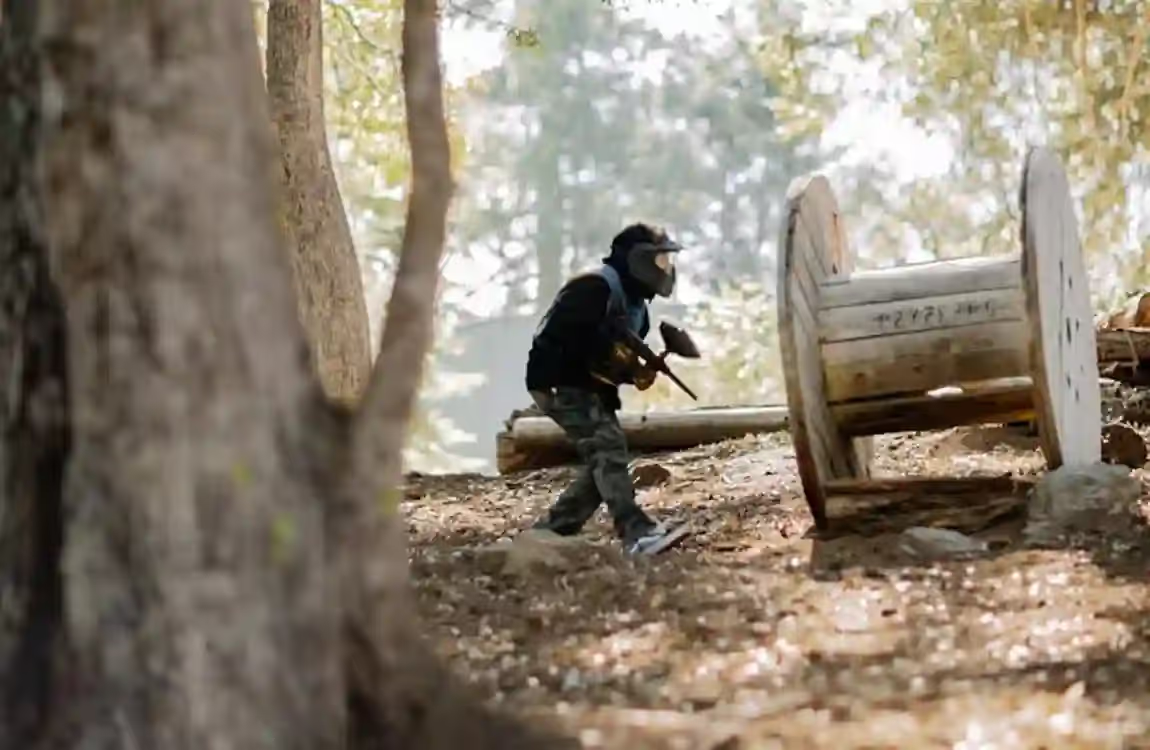
Even experienced players fall into habitual mistakes that undermine tactical effectiveness. Identifying and correcting these elevates performance.
Poor Communication or Tunnel Vision
The mistake: Players become so focused on their immediate engagement that they stop communicating or processing teammate calls. They develop tunnel vision on specific opponents or bunkers, losing awareness of overall field state.
The fix: Practice forced communication drills where you must call something every 5-10 seconds during play. Train yourself to continuously scan—opponent positions, teammate locations, field opportunities—rather than fixating on single elements. Use peripheral vision and quick head-check scans maintaining broad awareness.
Overlapping Fire Lanes with Teammates
The mistake: Multiple players shooting the same lanes or covering identical field sectors, leaving other areas undefended and wasting resources on redundant coverage.
The fix: Pre-game sector assignment. Verbally confirm "I've got left," "Covering snake," "Watching center" during breakouts and after movements. If you notice overlap, immediately redirect: "I've got snake, you take dorito."
Pushing Without Cover or Coordination
The mistake: Individual players attempting aggressive moves without ensuring teammates provide covering fire or without timing moves to opponent vulnerabilities. These solo-hero plays usually result in quick eliminations providing no team benefit.
The fix: Verbalize push intentions before moving: "Pushing snake when you suppress temple." Wait for teammate acknowledgment and covering fire before moving. If attempting opportunistic pushes (exploiting sudden opening without pre-planning), at minimum announce "Pushing snake!" so teammates can react with covering fire.
Ignoring Safety or Chronograph Requirements
The mistake: Treating safety equipment casually—improperly worn masks, skipping chronograph, ignoring barrel sock requirements, or removing protection in live play areas.
The fix: Develop pre-game safety ritual checking mask seal, chronographing marker with actual game paint (not test balls), verifying barrel sock attachment, and confirming field-specific safety rules. Make this ritual non-negotiable personal standard regardless of what others do.
Gear Over-Compensation: Skill Beats Equipment
The mistake: Believing expensive markers, premium paint, or extensive accessories compensate for tactical weaknesses or underdeveloped skills. Players invest thousands in gear while neglecting training and tactical development.
The fix: Establish personal skill baseline before major equipment investments. Can you consistently hit torso-sized targets at 75 feet? Execute clean snapshots with minimal exposure? Maintain awareness and communication under pressure? If not, invest in training and practice paint before upgrading equipment. A $250 marker in skilled hands beats a $1,500 marker in untrained hands consistently.
Woodsball and speedball represent paintball's tactical extremes—one rewards patience and terrain exploitation, the other explosive coordination and angular precision. Yet both share universal principles: communication transcends individual skill, teamwork beats talent, and tactical awareness determines outcomes more than shooting speed. The player who masters communication, maintains field awareness, and executes disciplined tactics will succeed in both formats despite their surface differences.
The path to tactical mastery begins with fundamentals—establishing clear communication protocols, understanding basic field geometry and positioning, and developing physical capabilities (conditioning, agility, accuracy) that tactics require. Once fundamentals are solid, format-specific refinement follows: woodsball players develop stealth, flanking execution, and patience reading terrain, while speedball players perfect breakout timing, snapshot technique, and push coordination.
Cross-training in both formats creates complete paintball players. Woodsball teaches patience, tactical flexibility, and reading complex environments—skills that translate to speedball in managing chaos and identifying opportunities. Speedball teaches explosive coordination, precise communication, and disciplined execution—skills that translate to woodsball in organizing team movements and maximizing efficiency. The best players aren't specialists limited to single formats—they're adaptable athletes who adjust tactics to whatever field they're playing.
Train consistently, prioritizing quality repetition over random play. Identify specific tactical weaknesses and design drills targeting those areas. Study successful players and teams, analyzing what makes them effective beyond raw skill. Build team cohesion through regular practice and positive culture. Most importantly, remember that paintball is ultimately a sport—maintain safety standards, respect opponents and officials, and preserve the positive community that makes paintball rewarding beyond competitive success.
Whether you're preparing for your first woodsball scenario event, training for regional speedball tournaments, or simply want to improve weekend recreational play, these tactics provide frameworks for immediate improvement. The fields are waiting—at facilities like Liberty Paintball, Paintball USA, High Velocity Paintball, and countless others nationwide. Apply these tactics, respect safety fundamentals with ASTM F1776-certified protection, and discover what makes paintball one of the most tactically complex and rewarding sports available. See you on the field.
NOVEMBER 10, 2025
OCTOBER 08, 2025
OCTOBER 08, 2025
OCTOBER 08, 2025